
29 July,2025
Your garage is more than just a parking space; it serves as a multifunctional place that can serve multiple purposes. Needless to say, your garage door plays multiple important roles. Not only does it add aesthetics, but it also keeps your home safe and secure.
Among the many options available, sectional doors and up-and-over doors are two of the most popular choices, each with its own distinct characteristics, advantages, and disadvantages.
Up-and-Over Doors: These doors work on a straightforward principle; the entire door panel pivots from a fixed point, swinging outward and then upward to rest parallel to the garage ceiling.
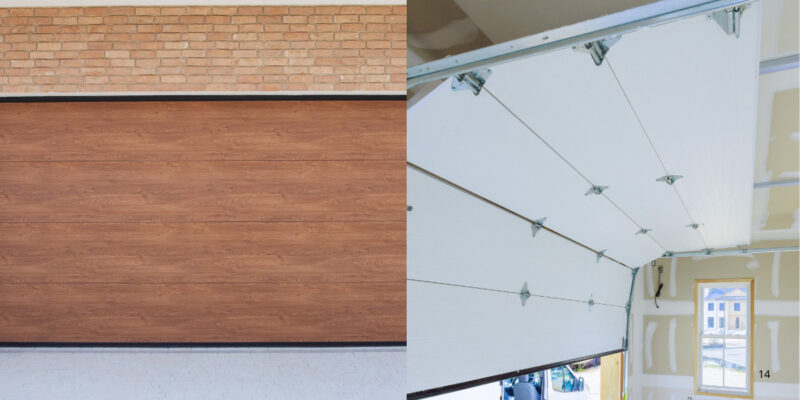
Sectional doors: In contrast, such doors are made of horizontal panels joined by hinges. As the door opens, these panels rise and follow ceiling-mounted rails, with each portion bending at the hinges to change from a vertical to a horizontal position.
In this blog, you will learn about the differences between sectional and up-and-over garage doors. This will help you make the correct decision and choose the correct type of garage door for your needs.
Let’s get started!
The sectional door is made of horizontal sections that rise vertically when open. It slides upwards along fixed guides.
On the other hand, the overhead door opens by lifting upwards and sliding inside the garage on rails that follow the ceiling line.
Up-and-over garage doors: Due to their design, they require significant clearance in front of your garage every time you open or close the door. Such garage doors can be problematic for:
Sectional garage doors: Since these doors are made of horizontal sections (or compartments), they don’t require clearance in front of your garage. Owing to their design, these doors are perfect for properties with shorter driveways
These mechanisms also utilize space differently inside your garage:
Up-and-over garage doors: These doors require less ceiling track depth but more ceiling space across the entire door width.
Sectional garage doors: They need more track depth.
Sectional garage doors: These doors provide superior safety and security in turbulent weather. This is because each section has its own seal, and the door closes straight down against the floor and frame.
Up-and-over garage doors: Unlike sectional doors, these doors have a continuous seal around their boundary. As a result, they still generally let in air and water at the edges compared to sectional designs. It becomes problematic during storms.
Sectional doors: These doors often provide better security characteristics:
Up-and-over garage doors: Though many changes have been made in recent years, these doors are still vulnerable to attacks. This happens because their lifting mechanism can sometimes be more susceptible to forced entry attempts.
Sectional doors: These doors are more expensive because:
Up-and-over garage doors: Such doors are more economical because:
Sectional doors: Such doors offer:
Up-and-over garage doors: The advantages include:
Read More:
Garage Door’s Broken Springs: What Causes It?
8 Questions to Ask Before Hiring a Garage Door Repair Company
To Wrap Up
Choosing between sectional and up-and-over garage doors boils down to balancing your specific needs with the distinct characteristics of each. With guidance from the Best Garage Door Repair Company, you can better understand which option suits your home and lifestyle.
Sectional doors excel in space efficiency, weather performance, and security, making them a premium choice for modern homes, especially those with limited driveway space.
On the other hand, up-and-over doors offer a more economical and traditionally appealing option with simpler mechanisms, though they demand more external clearance and may offer less robust weather sealing and security.
By considering these key differences, you can make an informed decision to select a garage door that best fits your property’s layout, budget, and functional requirements.
Leave a Reply